
Why PLM–ERP Integration Is Critical for Apparel Brands Manufacturing Overseas
Overseas manufacturing has become standard for apparel brands. What hasn’t kept pace is how product data moves once a style leaves design and enters production.
In many apparel organizations, design, sourcing, operations, and finance each operate in different systems. By the time a product is approved, teams are re-keying SKUs, reconciling spreadsheets, and debating which version of the BOM or cost is correct. These gaps may feel manageable early on, but once production is offshore, they quickly become expensive.
This is where PLM–ERP integration stops being a technical decision and becomes an operational necessity.

Two systems, one critical handoff
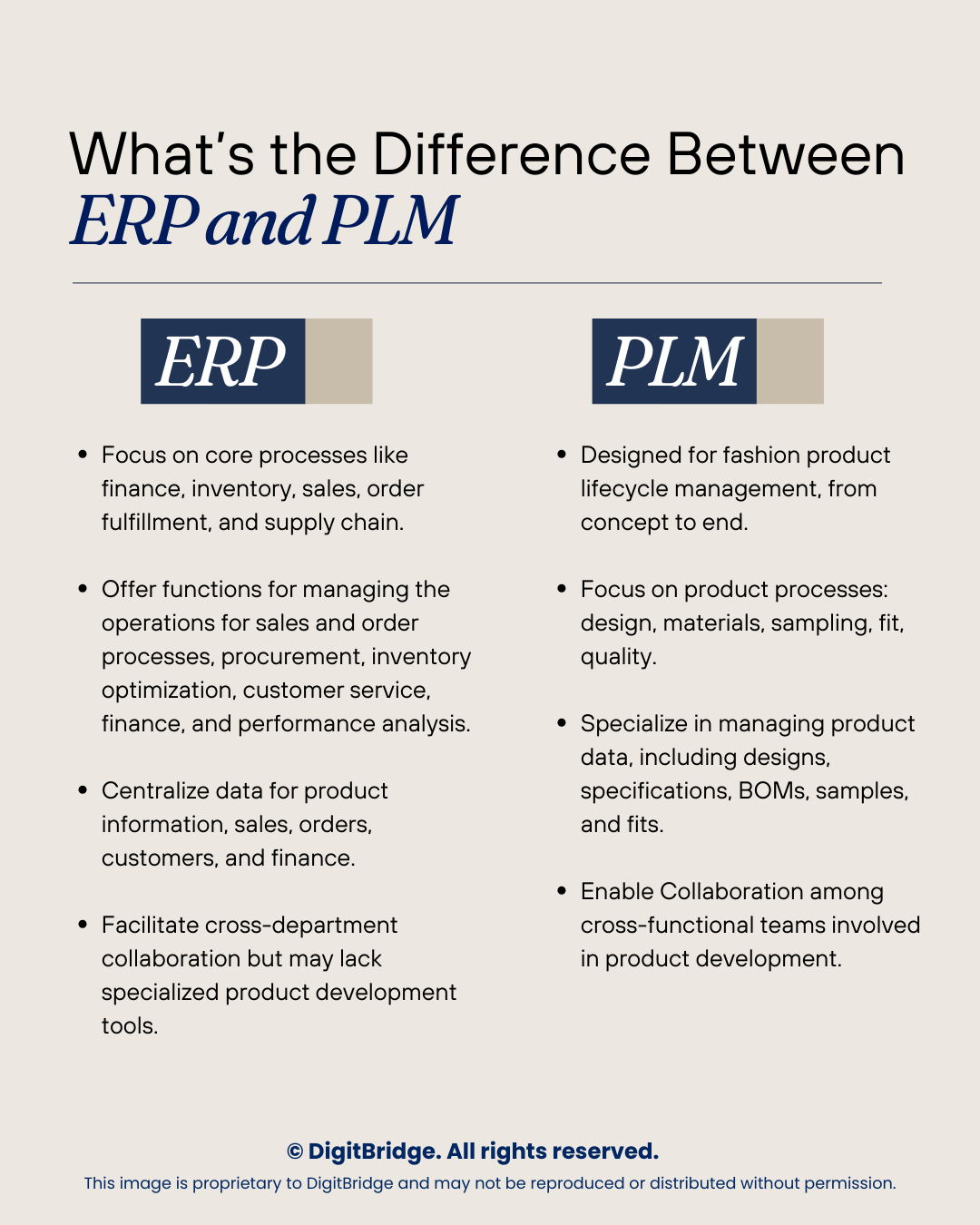
PLM and ERP serve very different roles in an apparel business.
PLM manages the front end of the product lifecycle—styles, tech packs, BOMs, costing, and vendor collaboration. ERP takes over once decisions turn into commitments: purchase orders, inventory, production timelines, landed cost, sales, fulfilments, customer service, performance analytics, and financials.
The moment a style moves from “approved” to “in production” is where integration matters most. When PLM and ERP are connected, approved product data flows directly into execution. When they are not, teams are forced to rebuild product structures downstream, introducing delays, errors, and version drift.
Why overseas manufacturing raises the stakes
Overseas production leaves little margin for correction. Lead times stretch months, not weeks. Currency fluctuations, freight volatility, and compliance requirements add constant complexity. A small data error upstream may not surface until inventory is already on the water—or worse, after it arrives.
PLM–ERP integration forces clarity early. Styles, BOMs, size runs, vendors, and cost assumptions move forward as a single, consistent data set. Instead of reacting to problems late in the cycle, teams execute against decisions that have already been locked and validated.

Why Print on Demand/Made-to-Order amplifies the need for integration
For apparel brands that also operate print-on-demand (POD) programs for other companies, the need for PLM–ERP integration is even more pronounced.
In a POD/MTO model, the brand is not only managing its own product catalog—it is acting as a manufacturing, customization, and fulfillment partner for external customers. Each customer may have unique artwork, variant rules, pricing agreements, branding requirements, and service-level expectations. That complexity multiplies quickly when designs, BOMs, and production instructions live in disconnected systems.
Without integration, POD operations often rely on manual handoffs, email-based approvals, and spreadsheets to track customer-specific designs and the transfer between the customer’s sales order and the P/O for manufacturing. This increases the risk of incorrect prints, missed turnaround times, inconsistent quality, and margin erosion. When PLM and ERP are connected, approved designs and specifications flow directly into execution, enabling faster order turnaround, better capacity planning, and the operational discipline required to scale POD without sacrificing reliability or profitability.
The operational impact teams actually feel
Brands that integrate PLM and ERP don’t describe it as “digital transformation.” They describe it as fewer fires.
They operate from a single source of truth—one approved BOM, one cost basis, one production version. Time to production shortens because nothing needs to be recreated after approval. Costing becomes reliable before capital is committed, not after inventory is already in transit.
Factories receive clearer production orders, reducing sampling loops, chargebacks, and last-minute corrections. Inventory planning improves because ERP forecasts and allocations are based on real product data, not assumptions. And post-season performance—actual landed cost, vendor reliability, sell-through—feeds directly into the next season instead of living in disconnected reports.
The cost of staying disconnected
When PLM and ERP remain siloed, the symptoms are familiar: Excel bridges, manual SKU creation, cost mismatches, late POs, overbuying, and unexplained margin erosion. In overseas manufacturing—and especially in POD models—those inefficiencies compound quickly.
At scale, the cost is no longer just operational frustration. It is lost margin, strained customer relationships, and limited ability to grow.
Where DigitBridge fits
PLM–ERP integration only delivers value if the ERP is built for how apparel businesses actually operate.
DigitBridge is designed to take approved product data—styles, size and color matrices, BOMs, vendors, customer-specific variants, and costs—and turn it into clean execution across purchasing, inventory, fulfillment, sales, customer service, fulfillments, analytics, and financials. Rather than forcing teams to rebuild product structures after development, DigitBridge serves as the operational backbone once a product moves from idea to inventory or into on-demand production.
If your team already invests in PLM but still experiences friction once styles move into production, POD fulfillment, and downstream execution, that gap is exactly where DigitBridge operates.

DigitBridge helps apparel brands manufacturing overseas and/or domestically—including those running Print on Demand programs—execute with confidence, scale operations, and maintain control once real money, customer satisfaction, and relationships are on the line.