
Unified Commerce Platform for Marketplace Commerce

DigitBridge unifies marketplace, wholesale, and DTC operations on a single commerce platform, helping businesses expand into new channels while maintaining visibility, efficiency, and operational control.

Expand Across Marketplaces Without Expanding Complexity

Marketplaces have become a critical growth channel for both B2C and B2B commerce. From Amazon, Walmart Marketplace, TikTok Shop, and Temu to industry-specific wholesale marketplaces, businesses can reach new customers and generate additional revenue through a growing network of digital channels.

However, managing multiple marketplaces often creates challenges around product data, inventory, orders, fulfillment, and supplier coordination.

Unified Commerce Platform for Marketplace Commerce

Expand Across Marketplaces Without Expanding Complexity

Marketplaces have become a critical growth channel for both B2C and B2B commerce. From Amazon, Walmart Marketplace, TikTok Shop, and Temu to industry-specific wholesale marketplaces, businesses can reach new customers and generate additional revenue through a growing network of digital channels.
However, managing multiple marketplaces often creates challenges around product data, inventory, orders, fulfillment, and supplier coordination.

DigitBridge unifies marketplace, wholesale, and DTC operations on a single commerce platform, helping businesses expand into new channels while maintaining visibility, efficiency, and operational control.

Marketplaces Are Changing Commerce


Today’s buyers do not always begin their purchasing journey on a brand’s website.

Consumers increasingly discover and purchase products through marketplaces such as:

DigitBridge | Marketplace Commerce 26/07

Amazon

DigitBridge | Marketplace Commerce 26/07

Walmart Marketplace

DigitBridge | Marketplace Commerce 26/07

TikTok Shop

DigitBridge | Marketplace Commerce 26/07

Temu

DigitBridge | Marketplace Commerce 26/07

SHEIN

DigitBridge | Marketplace Commerce 26/07

Emerging social and commerce channels

DigitBridge | Marketplace Commerce 26/07

Retail marketplaces

At the same time, business buyers and retailers are sourcing products through B2B marketplaces and digital wholesale platforms such as:

DigitBridge | Marketplace Commerce 26/07

Faire

DigitBridge | Marketplace Commerce 26/07

NuOrder

DigitBridge | Marketplace Commerce 26/07

Industry-specific B2B marketplaces

DigitBridge | Marketplace Commerce 26/07

Wholesale sourcing networks

DigitBridge | Marketplace Commerce 26/07

Retailer purchasing platforms

DigitBridge | Marketplace Commerce 26/07

Digital procurement channels

As marketplace adoption continues to accelerate across both B2C and B2B commerce, brands are expanding their marketplace presence to reach new customers, strengthen retail relationships, enter new markets, and diversify revenue streams.

The opportunity is significant. The challenge is operational.

Marketplaces Are Changing Commerce


Today’s buyers do not always begin their purchasing journey on a brand’s website.

Consumers increasingly discover and purchase products through marketplaces such as:

DigitBridge | Marketplace Commerce 26/07

Amazon

DigitBridge | Marketplace Commerce 26/07

Walmart Marketplace

DigitBridge | Marketplace Commerce 26/07

TikTok Shop

DigitBridge | Marketplace Commerce 26/07

Temu

DigitBridge | Marketplace Commerce 26/07

SHEIN

DigitBridge | Marketplace Commerce 26/07

Emerging social and commerce channels

DigitBridge | Marketplace Commerce 26/07

Retail marketplaces

At the same time, business buyers and retailers are sourcing products through B2B marketplaces and digital wholesale platforms such as:

DigitBridge | Marketplace Commerce 26/07

Faire

DigitBridge | Marketplace Commerce 26/07

NuOrder

DigitBridge | Marketplace Commerce 26/07

Industry-specific B2B marketplaces

DigitBridge | Marketplace Commerce 26/07

Wholesale sourcing networks

DigitBridge | Marketplace Commerce 26/07

Retailer purchasing platforms

DigitBridge | Marketplace Commerce 26/07

Digital procurement channels

As marketplace adoption continues to accelerate across both B2C and B2B commerce, brands are expanding their marketplace presence to reach new customers, strengthen retail relationships, enter new markets, and diversify revenue streams.
The opportunity is significant. The challenge is operational.

Marketplace Growth Creates Operational Complexity

Every marketplace has its own operational requirements, processes, and performance standards.
To succeed across both B2C and B2B marketplaces, businesses must manage:
  • Product listings and catalog management
  • Product content and marketplace optimization
  • Inventory synchronization across channels
  • Pricing and promotion updates
  • Order processing and routing
  • Fulfillment and shipping workflows
  • Marketplace compliance requirements
  • Performance monitoring and analytics
  • Returns and refund management
  • Payment reconciliation and reporting
DigitBridge | Marketplace Commerce 26/07
Many businesses manage these processes separately for each marketplace using disconnected systems and manual workflows.
Over time, this often leads to:
DigitBridge | Marketplace Commerce 26/07

Inventory discrepancies

DigitBridge | Marketplace Commerce 26/07

Inconsistent product information

DigitBridge | Marketplace Commerce 26/07

Overselling and stock allocation issues

DigitBridge | Marketplace Commerce 26/07

Increased operational costs

DigitBridge | Marketplace Commerce 26/07

Manual inefficiencies

DigitBridge | Marketplace Commerce 26/07

Limited visibility across channels

DigitBridge | Marketplace Commerce 26/07

Challenges scaling marketplace growth

The challenge is not joining a marketplace.

The challenge is managing multiple marketplaces as part of a unified commerce operation.

Marketplace Growth Creates Operational Complexity

Every marketplace has its own operational requirements, processes, and performance standards.
To succeed across both B2C and B2B marketplaces, businesses must manage:
  • Product listings and catalog management
  • Product content and marketplace optimization
  • Inventory synchronization across channels
  • Pricing and promotion updates
  • Order processing and routing
  • Fulfillment and shipping workflows
  • Marketplace compliance requirements
  • Performance monitoring and analytics
  • Returns and refund management
  • Payment reconciliation and reporting
DigitBridge | Marketplace Commerce 26/07
Many businesses manage these processes separately for each marketplace using disconnected systems and manual workflows.
Over time, this often leads to:
DigitBridge | Marketplace Commerce 26/07

Inventory discrepancies

DigitBridge | Marketplace Commerce 26/07

Inconsistent product information

DigitBridge | Marketplace Commerce 26/07

Overselling and stock allocation issues

DigitBridge | Marketplace Commerce 26/07

Increased operational costs

DigitBridge | Marketplace Commerce 26/07

Manual inefficiencies

DigitBridge | Marketplace Commerce 26/07

Limited visibility across channels

DigitBridge | Marketplace Commerce 26/07

Challenges scaling marketplace growth

The challenge is not joining a marketplace.

The challenge is managing multiple marketplaces as part of a unified commerce operation.

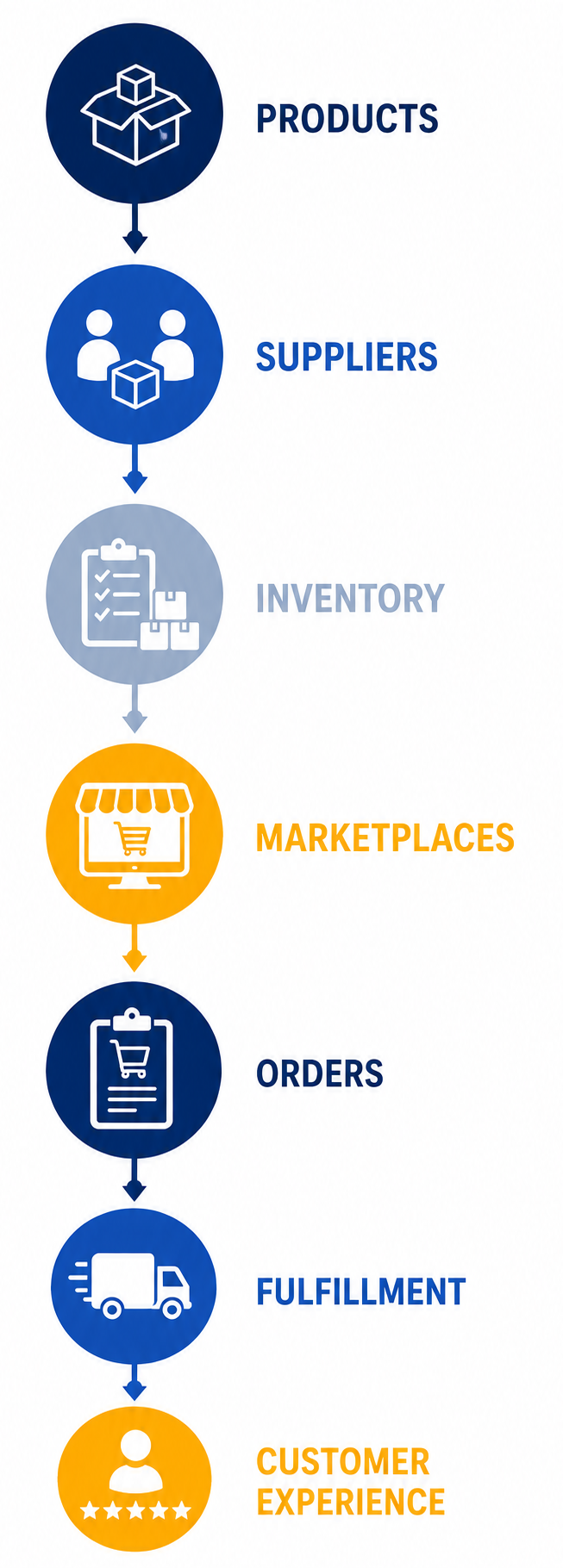
Unified Commerce Platform Connects Marketplace Operations


Many marketplace initiatives fail not because of a lack of opportunity, but because operations become fragmented across disconnected systems, teams, and workflows. A Unified Commerce Platform eliminates these silos by creating a connected operating model:

DigitBridge | Marketplace Commerce 26/07

Every marketplace operates from the same source of truth, with shared product data, synchronized inventory, centralized order management, and coordinated fulfillment processes. This enables businesses to expand across both B2C and B2B marketplaces while maintaining data accuracy, operational consistency, and complete visibility across the entire commerce operation.

Unified Commerce Platform Connects Marketplace Operations


Many marketplace initiatives fail not because of a lack of opportunity, but because operations become fragmented across disconnected systems, teams, and workflows. A Unified Commerce Platform eliminates these silos by creating a connected operating model:
DigitBridge | Marketplace Commerce 26/07

Every marketplace operates from the same source of truth, with shared product data, synchronized inventory, centralized order management, and coordinated fulfillment processes. This enables businesses to expand across both B2C and B2B marketplaces while maintaining data accuracy, operational consistency, and complete visibility across the entire commerce operation.

Built for Marketplace Growth


DigitBridge | Marketplace Commerce 26/07

Centralized Product Management

Manage product information and digital commerce operations from a single source of truth. Maintain and centralize:

  • Product copywritings and descriptions
  • Product images
  • Digital assets and media
  • Product attributes and specifications
  • Marketing content
  • Channel-specific product catalogs
  • Marketplace sales promotions

Create product information once and distribute it automatically according to the unique requirements of each marketplace.

DigitBridge | Marketplace Commerce 26/07

Inventory Synchronization

Accurate inventory visibility is essential for marketplace success. DigitBridge provides real-time inventory synchronization and Available-to-Sell (ATS) management across your entire commerce ecosystem, including:

  • Marketplaces
  • Ecommerce stores
  • Wholesale channels
  • Warehouses
  • 3PL providers
  • Retail partners
  • Dropship suppliers

Maintain a single view of inventory across all channels while controlling inventory allocations, availability, and replenishment.

DigitBridge | Marketplace Commerce 26/07

Unified Order Management

Centralize and manage orders from every marketplace through a single integrated platform. Streamline order operations across:

  • Amazon orders
  • Walmart Marketplace orders
  • TikTok Shop orders
  • Faire orders
  • B2B marketplace orders
  • Additional marketplace and commerce channels

DigitBridge automatically consolidates marketplace orders into a unified workflow, providing complete visibility from order receipt through fulfillment.

DigitBridge | Marketplace Commerce 26/07

Marketplace Fulfillment Management

Successfully selling across both B2C and B2B marketplaces requires a fulfillment operation that can support diverse order types, customer expectations, and delivery requirements. DigitBridge helps businesses coordinate marketplace fulfillment across:

  • Internal warehouses
  • Third-party logistics (3PL) providers
  • Dropship suppliers
  • Marketplace fulfillment programs (FBA, WFS, and others)
  • Wholesale distribution operations
  • Direct-to-consumer shipping operations

By connecting marketplace orders, inventory, fulfillment locations, and logistics partners, DigitBridge provides end-to-end visibility throughout the fulfillment lifecycle—from order creation to delivery.

DigitBridge | Marketplace Commerce 26/07

Marketplace Performance Insights

Success in marketplace commerce requires more than managing orders—it requires visibility into performance across products, channels, inventory, and profitability.
DigitBridge provides real-time insights into:

  • Product sales performance
  • Inventory availability and stock turnover
  • Order volume and fulfillment activity
  • Returns and refund trends
  • Marketplace growth and performance
  • Channel profitability
  • Customer purchasing behavior
  • Demand and sales trends

By consolidating marketplace data into a single platform, businesses gain a complete view of performance across both B2C and B2B marketplaces.

Built for Marketplace Growth


DigitBridge | Marketplace Commerce 26/07

Centralized Product Management

Manage product information and digital commerce operations from a single source of truth. Maintain and centralize:

  • Product copywritings and descriptions
  • Product images
  • Digital assets and media
  • Product attributes and specifications
  • Marketing content
  • Channel-specific product catalogs
  • Marketplace sales promotions

Create product information once and distribute it automatically according to the unique requirements of each marketplace.

DigitBridge | Marketplace Commerce 26/07

Inventory Synchronization

Accurate inventory visibility is essential for marketplace success. DigitBridge provides real-time inventory synchronization and Available-to-Sell (ATS) management across your entire commerce ecosystem, including:

  • Marketplaces
  • Ecommerce stores
  • Wholesale channels
  • Warehouses
  • 3PL providers
  • Retail partners
  • Dropship suppliers

Maintain a single view of inventory across all channels while controlling inventory allocations, availability, and replenishment.

DigitBridge | Marketplace Commerce 26/07

Unified Order Management

Centralize and manage orders from every marketplace through a single integrated platform. Streamline order operations across:

  • Amazon orders
  • Walmart Marketplace orders
  • TikTok Shop orders
  • Faire orders
  • B2B marketplace orders
  • Additional marketplace and commerce channels

DigitBridge automatically consolidates marketplace orders into a unified workflow, providing complete visibility from order receipt through fulfillment.

DigitBridge | Marketplace Commerce 26/07

Marketplace Fulfillment Management

Successfully selling across both B2C and B2B marketplaces requires a fulfillment operation that can support diverse order types, customer expectations, and delivery requirements. DigitBridge helps businesses coordinate marketplace fulfillment across:

  • Internal warehouses
  • Third-party logistics (3PL) providers
  • Dropship suppliers
  • Marketplace fulfillment programs (FBA, WFS, and others)
  • Wholesale distribution operations
  • Direct-to-consumer shipping operations

By connecting marketplace orders, inventory, fulfillment locations, and logistics partners, DigitBridge provides end-to-end visibility throughout the fulfillment lifecycle—from order creation to delivery.

DigitBridge | Marketplace Commerce 26/07

Marketplace Performance Insights

Success in marketplace commerce requires more than managing orders—it requires visibility into performance across products, channels, inventory, and profitability.
DigitBridge provides real-time insights into:

  • Product sales performance
  • Inventory availability and stock turnover
  • Order volume and fulfillment activity
  • Returns and refund trends
  • Marketplace growth and performance
  • Channel profitability
  • Customer purchasing behavior
  • Demand and sales trends

By consolidating marketplace data into a single platform, businesses gain a complete view of performance across both B2C and B2B marketplaces.

Why Businesses Invest in Marketplace Commerce


DigitBridge | Marketplace Commerce 26/07

Reach New Customers

Expand beyond your existing audience and increase brand visibility.

DigitBridge | Marketplace Commerce 26/07

Diversify Revenue Streams

Reduce dependence on any single sales channel.

DigitBridge | Marketplace Commerce 26/07

Accelerate Growth

Leverage established marketplace traffic and customer demand.

DigitBridge | Marketplace Commerce 26/07

Improve Operational Efficiency

Manage multiple marketplaces from a single platform.

DigitBridge | Marketplace Commerce 26/07

Create a Scalable Marketplace Strategy

Support growth across new marketplaces without creating operational silos.

Why Businesses Invest in Marketplace Commerce


DigitBridge | Marketplace Commerce 26/07

Reach New Customers

Expand beyond your existing audience and increase brand visibility.

DigitBridge | Marketplace Commerce 26/07

Diversify Revenue Streams

Reduce dependence on any single sales channel.

DigitBridge | Marketplace Commerce 26/07

Accelerate Growth

Leverage established marketplace traffic and customer demand.

DigitBridge | Marketplace Commerce 26/07

Improve Operational Efficiency

Manage multiple marketplaces from a single platform.

DigitBridge | Marketplace Commerce 26/07

Create a Scalable Marketplace Strategy

Support growth across new marketplaces without creating operational silos.

DigitBridge | Marketplace Commerce 26/07

Marketplace Success Requires More Than Listings

Listing products is only the first step. Long-term marketplace success depends on inventory accuracy, product content quality, order fulfillment performance, pricing strategy, and operational coordination across channels.

DigitBridge helps businesses unify marketplace, wholesale, and DTC operations on a single commerce platform, enabling scalable growth with greater visibility, control, and efficiency.

Marketplace Success Requires More Than Listings

Listing products is only the first step. Long-term marketplace success depends on inventory accuracy, product content quality, order fulfillment performance, pricing strategy, and operational coordination across channels.
DigitBridge helps businesses unify marketplace, wholesale, and DTC operations on a single commerce platform, enabling scalable growth with greater visibility, control, and efficiency.

DigitBridge | Marketplace Commerce 26/07

Frequently asked questions


What is Marketplace Commerce?

Marketplace Commerce refers to selling products through third-party online marketplaces such as Amazon, Walmart Marketplace, TikTok Shop, Faire, and other digital commerce platforms.

Why are businesses selling on marketplaces?

Marketplaces provide access to large customer audiences, built-in traffic, and new revenue opportunities without requiring businesses to acquire every customer independently.

What are the biggest challenges of marketplace selling?

Common challenges include inventory synchronization, listing management, order processing, fulfillment coordination, pricing control, marketplace compliance, and managing multiple channels simultaneously.

How do businesses manage multiple marketplaces?

The most effective approach is to centralize products, inventory, orders, channels, and fulfillment within a unified platform that connects all marketplaces through a single source of truth.

How does Unified Commerce Platform improve marketplace operations?

Unified Commerce Platform connects products, inventory, orders, fulfillment, suppliers, and marketplace channels into a single operating model, reducing operational complexity while improving visibility and efficiency.

Can DigitBridge support Amazon, Walmart Marketplace, and TikTok Shop?

Yes. DigitBridge helps businesses manage products, inventory, orders, fulfillment, suppliers, and marketplace operations across Amazon, Walmart Marketplace, TikTok Shop, Faire, and other B2B and B2C marketplaces from a single Unified Commerce Platform.

How does inventory synchronization work across marketplaces?

Inventory synchronization maintains real-time visibility and control of inventory across marketplaces, ecommerce stores, wholesale channels, warehouses, 3PL providers, and other sales channels.
As inventory levels change due to sales, returns, transfers, or replenishment activities, available inventory and channel allocations are automatically updated across connected channels.

Should businesses sell through both marketplaces and their own website?

Many successful brands and retailers use both strategies. Marketplaces help acquire customers and expand reach quickly, while owned ecommerce channels help strengthen customer relationships and increase long-term customer value.

Frequently asked questions


What is Marketplace Commerce?

Marketplace Commerce refers to selling products through third-party online marketplaces such as Amazon, Walmart Marketplace, TikTok Shop, Faire, and other digital commerce platforms.

Why are businesses selling on marketplaces?

Marketplaces provide access to large customer audiences, built-in traffic, and new revenue opportunities without requiring businesses to acquire every customer independently.

What are the biggest challenges of marketplace selling?

Common challenges include inventory synchronization, listing management, order processing, fulfillment coordination, pricing control, marketplace compliance, and managing multiple channels simultaneously.

How do businesses manage multiple marketplaces?

The most effective approach is to centralize products, inventory, orders, channels, and fulfillment within a unified platform that connects all marketplaces through a single source of truth.

How does Unified Commerce Platform improve marketplace operations?

Unified Commerce Platform connects products, inventory, orders, fulfillment, suppliers, and marketplace channels into a single operating model, reducing operational complexity while improving visibility and efficiency.

Can DigitBridge support Amazon, Walmart Marketplace, and TikTok Shop?

Yes. DigitBridge helps businesses manage products, inventory, orders, fulfillment, suppliers, and marketplace operations across Amazon, Walmart Marketplace, TikTok Shop, Faire, and other B2B and B2C marketplaces from a single Unified Commerce Platform.

How does inventory synchronization work across marketplaces?

Inventory synchronization maintains real-time visibility and control of inventory across marketplaces, ecommerce stores, wholesale channels, warehouses, 3PL providers, and other sales channels.
As inventory levels change due to sales, returns, transfers, or replenishment activities, available inventory and channel allocations are automatically updated across connected channels.

Should businesses sell through both marketplaces and their own website?

Many successful brands and retailers use both strategies. Marketplaces help acquire customers and expand reach quickly, while owned ecommerce channels help strengthen customer relationships and increase long-term customer value.

Unified Commerce for Modern 3PL Providers

DigitBridge helps 3PL providers unify inventory, fulfillment, client operations, shipping carrier integration, and commerce connectivity into a single operation platform—creating the digital foundation for scalable logistics operations and long-term client success.

Book a Demo

Connect Warehousing, Fulfillment, Inventory, and Client Operations in One Platform

Today’s 3PL providers are expected to do far more than move inventory. Clients expect real-time inventory visibility, ecommerce connectivity, marketplace integrations, fulfillment transparency, reporting, and seamless operational coordination across every sales channel.